
The inter-ministerial committee will coordinate investigation against Rajiv Gandhi Foundation, Rajiv Gandhi Charitable Trust and Indira Gandhi Memorial Trust.
The Prime Minister directed that a special cell be created immediately in the Cabinet Secretariat.

'One wishes that today's 'take no prisoners' brand of politics would give way to an understanding of the national interest that is shared by both government and Opposition.'
Kamal Nath will need to watch his back because given the slender majority, there is no doubt that the BJP will try to topple his government.

Rahul Khullar's guiding credo was that a civil servant must never lose sight of his client: The little guy. The evil men are those who are decision-makers but abdicate their responsibility of taking decisions, leading people to lose confidence in public institutions.
Economists who get too close to prime ministers eventually come to grief after their boss is defeated

It would be a good idea to create independent oversight committees for each regulatory institution and indeed, even for their appellate bodies, says A K Bhattacharya.

The government's annual Economic Survey on Friday strongly defended new farm laws, saying they herald a new era of market freedom which can go a long way in improving lives of small and marginal farmers in India. These legislations were designed "primarily" for the benefit of "small and marginal farmers", which constitute around 85 per cent of the total number of farmers and are the biggest sufferer of the "regressive" APMC-regulated market regime, the survey said. The pre-budget document defended the farm laws in the backdrop of long-running farmers' agitation at various borders of the national capital seeking repeal of these legislations expressing concern that they are pro-corporate and could weaken government regulated mandis, also called Agriculture Produce Marketing Committees (APMCs).

As cricketing ability goes, there is no comparison between Sanjay Manjrekar and Sachin Tendulkar. But while the former has produced a wonderful autobiography, the latter's book is deadly dull. In batting, they were the exact opposite: Manjrekar was a bore and Sachin an absolute marvel, says T C A Srinivasa-Raghavan.
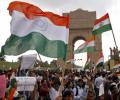
Set up by India's first Prime Minister Jawaharlal Nehru, the Planning Commission brought 12 five-year plans and six annual plans involving fund outlays of over Rs 200 lakh crore in its nearly 65-year-history.


For a bunch that fancies itself so greatly and does not hesitate to express an opinion on everything, this is very odd behaviour, says T C A Srinivasa-Raghavan.

Assessment note says panel acts as control commission, especially in fund allocations to states.

'A lot will depend on the first Aayog and the power it derives.'
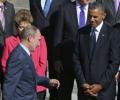
The G20 summit has failed to heal the rift over US plans for military action against the embattled Syrian regime, as American President Barack Obama and his Russian counterpart Vladimir Putin could not reach consensus on Friday during "candid and constructive" talks.
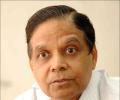
Status to enable Arvind Panagariya to attend Cabinet meetings.
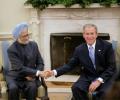
In the mid-1980s, India and the US struggled to arrive at sufficient confidence for Washington to even sell a supercomputer to India for monsoon prospecting. Now, the most sensitive military technologies, data, and intelligence resources are being shared. This would not have happened without that one, big deal that changed the fundamentals of India-US relations, notes Shekhar Gupta.

If Modi's truly a reformer and a believer in minimum government, he would bury the Vodafone ghosts now. He would also then go to Bihar, campaigning on his politically controversial reforms. Both will need him to dip deep into his accumulated political capital and risk it, suggests Shekhar Gupta.
The luncheon at his residence was attended by Planning Commission Deputy Chairman Montek Ahluwalia, Chairman of PM's Economic Advisory Council C Rangarajan, former RBI Governor Bimal Jalan, Foreign Secretary Shiv Shanker Menon and officials of the Prime Minister's Office.

If the EC decides to put on hold a gas price revision for RIL, it would set a precedent for pricing decisions of the government and policy decisions taken but undergoing procedural delays.

Pakistani Prime Minister Nawaz Sharif has cancelled his visit to WEF annual meeting after a deadly Taliban attack in his country.
The annual talk-fest of rich and powerful from across the world in snow-laden Alpine resort town of Davos will be attended by nearly 40 heads of government among more than 2,500 global leaders from over 100 countries.

A Ganesh Nadar listens in during Congress spokesperson Sanjay Jha's speech to the IMC in Mumbai.
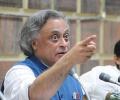
During the Congress regime, India did witnessa slew of reforms which are now taken up by the Modi government too.

Shares of rate sensitive sectors such as realty, infrastructure, banking and automobiles ended higher ahead of the Reserve Bank of India (RBI) mid-quarter policy review on June 17.
Internal report, to be finalised in seven-10 days, may also suggest reduction in subsidies

The original idea was to replace the existing schemes for scheduled castes and tribes.

Those scheduled to attend the five-day WEF Annual meeting, beginning January 21, include more than 40 heads of state or government, including those from the UK, Australia, Japan, Iran, Israel, Pakistan, Brazil, Italy, Mauritius, Republic of Korea and Switzerland, WEF announced on Wednesday at a press conference in Geneva.
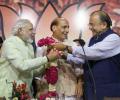
Modi has the ideas for a new, hopeful India, and an idiom in which to sell optimism to voters. But he doesn't yet have the team for it, and soon enough, questions will begin to be asked by an impatient, non-ideological, I-don't-owe-anybody-anything generation of Indian voters, says Shekar Gupta.

What the Indian economy looks like next January will influence her view on India, not her genetics, notes Shekhar Gupta.

'Similarly, he is against Dalits forgetting that the only way to get rid of poverty is to empower poor people.'
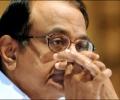
'Chidambaram, lots of people argue not without justification, is all about bluff and bluster without any concrete achievement on the ground. His record in the finance ministry fully endorses that view,' argues Virendra Kapoor.

'We first need to acknowledge the truth.' 'We are trying to diminish the problem and say, everything is okay and green shoots are emerging.' 'Imagine you are a doctor and not getting accurate medical reports, how do you diagnose and treat the illness?' 'We are not dealing with a terminal illness here, we are dealing with BP and cholesterol, which are imminently curable.'

Presenting the Top 20 of 100 science colleges as per India Today's findings.
Presenting the Top 20 of 100 science colleges as per India Today's findings.
The Planning Commission has not been central to the policy making process since the mid-1960s, says Nitin Desai.

I still believe that it is a good thing that think tanks are mushrooming in Delhi. They provide a platform for discussion, even if they shed more heat than light. With Parliament almost incapable of serious debate, informed discussion and civilised discourse, where does this nation get its intellectual churn, asks Mohan Guruswamy.
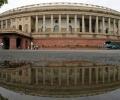
When Prime Minister Narendra Modi recently extended a Rs 8,000-crore (Rs 80 billion) central support for building roads in Jammu & Kashmir, Union Cabinet's approval for the big-ticket announcement came in barely 48 hours.
